Every experienced bettor knows that higher odds are better. What many people do not realise is exactly how much those small improvements are worth over hundreds of bets.
A difference of just 0.05 or 0.10 in decimal odds may seem insignificant, but repeated consistently, it can add hundreds or even thousands to your long-term profits.
This is why professional bettors treat line shopping as an essential part of their betting process rather than an optional extra.
Expected Value (EV) measures the average amount you expect to win or lose if the same bet could be placed repeatedly under identical conditions.
When you obtain a higher price for the same outcome, your expected value immediately increases.
Importantly, nothing about the match has changed.
That small increase in price directly translates into higher long-term profitability.
You can estimate the additional value created by a better price using the following formula.
EV Difference = Stake × (Price A − Price B) × True Probability of Winning
Where:
Suppose you stake £100 on a selection.
Applying the formula:
EV Difference = £100 × (2.20 − 2.10) × 0.45
= £100 × 0.10 × 0.45
= £4.50
Simply choosing the higher odds increases your expected value by £4.50 on that single bet.
No additional prediction skill was required.
Small improvements become surprisingly valuable when repeated consistently.
Suppose you achieve the same £4.50 improvement on 200 bets during a year.
200 × £4.50 = £900
That is approximately £900 in additional expected profit, achieved solely through better price selection.
This demonstrates why professional bettors spend so much time comparing bookmaker prices before placing their wagers.
Across a large number of bets, the effect of the true probability averages out.
For practical planning, many bettors use a simplified approximation:
Annual Gain ≈ Annual Stake Volume × Average Price Improvement
Although less precise than the full expected value calculation, this shortcut provides a quick estimate of how much line shopping is worth over an entire betting season.
The table below illustrates how seemingly tiny improvements can produce meaningful long-term gains.
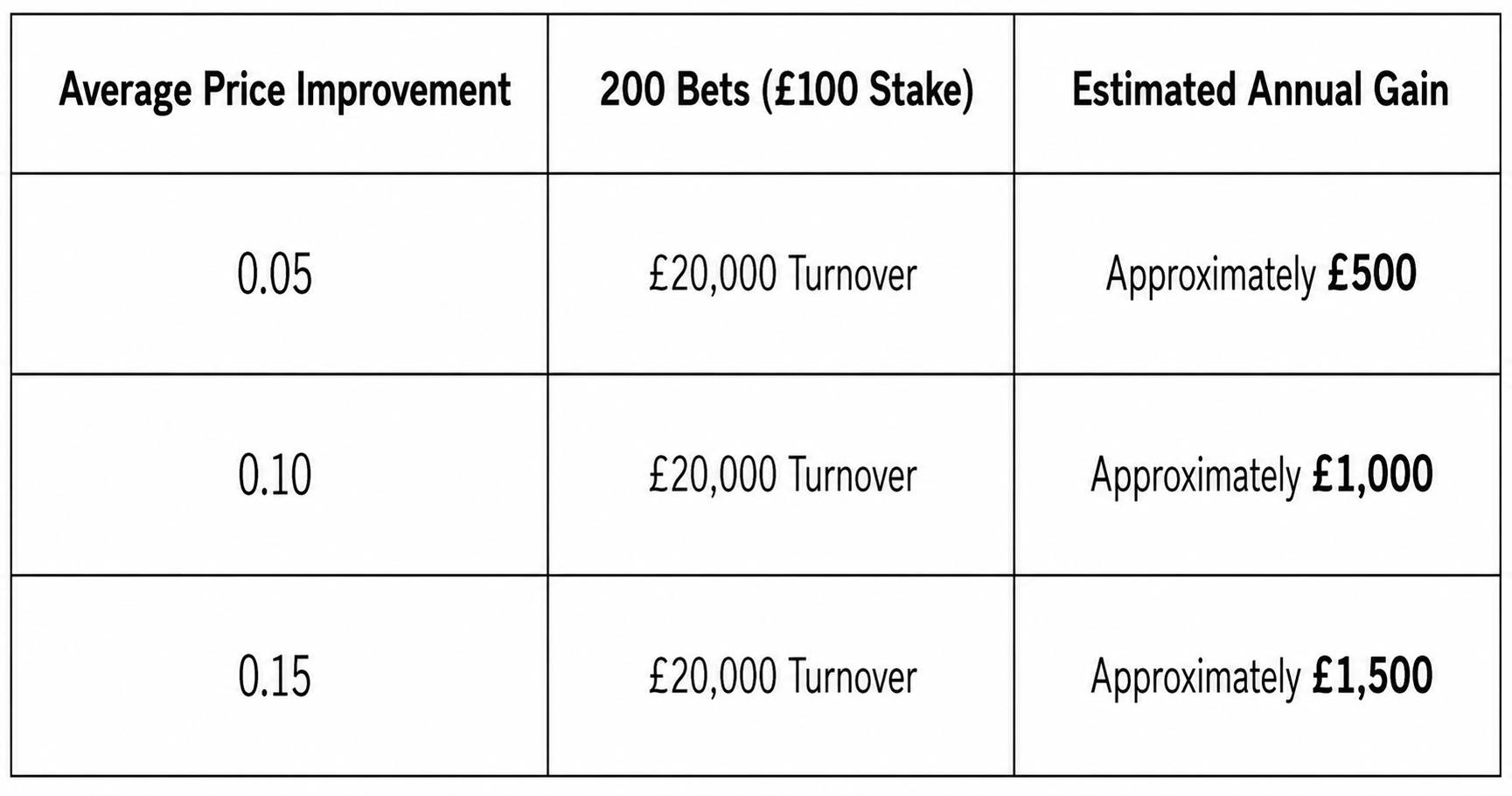
These gains come entirely from obtaining better prices—not from improving prediction accuracy.
Return on Investment (ROI) measures how much profit you generate relative to the amount you stake.
Imagine a bettor who has developed a betting strategy producing a genuine 3% ROI.
Through disciplined line shopping, they improve their effective return by an additional 2%.
Their total ROI becomes 5%.
This represents a profitability increase of approximately 67%, achieved without making better predictions.
Few changes to a betting strategy can produce such a dramatic improvement with so little effort.
Before placing every bet, develop the following routine:
Most of the time, this process takes less than a minute.
Over hundreds of bets, those extra seconds can be worth hundreds or even thousands in additional expected profit.
Small improvements in betting odds create meaningful increases in expected value over time. Even a difference of 0.05 or 0.10 in decimal odds can generate substantial additional profit when repeated consistently across hundreds of bets. By making line shopping a routine part of your betting process, you improve your long-term ROI without changing your predictions, your staking plan, or your betting strategy.
