Most betting strategies require you to predict outcomes more accurately than the bookmaker. Sports arbitrage is different.
Instead of trying to predict who will win, arbitrage bettors exploit pricing differences between bookmakers to lock in a guaranteed profit regardless of the result.
This is possible because bookmakers do not always update their prices at the same speed. For a short period, two or more bookmakers may disagree enough that every possible outcome can be covered profitably.
Although arbitrage is mathematically risk-free when executed correctly, it comes with practical challenges that make it difficult to sustain over the long term.
Sports arbitrage, often called arbing, occurs when the combined implied probabilities of the best available odds for every possible outcome add up to less than 100%.
When this happens, it is possible to place bets on every outcome and guarantee a profit no matter what happens.
Unlike value betting, arbitrage does not require estimating the true probability of an event.
The mathematics alone creates the opportunity.
Imagine a tennis match with only two possible outcomes.
Two bookmakers offer the following odds:
To check whether an arbitrage opportunity exists, calculate the sum of the implied probabilities.
1 ÷ 2.20 + 1 ÷ 2.10
0.4545 + 0.4762 = 0.9307
Expressed as a percentage:
93.07%
Because the total is below 100%, an arbitrage opportunity exists.
The remaining percentage represents the theoretical profit margin available.
The profit percentage can be calculated using:
Profit Margin = (1 ÷ Total Implied Probability) − 1
Using the previous example:
(1 ÷ 0.9307) − 1 = 0.0745
This produces an arbitrage margin of approximately 7.45%.
In theory, every £100 invested would return approximately £107.45 regardless of the winner.
To guarantee the same return whichever outcome wins, the stakes must be divided proportionally.
The formulas are:
Stake on Outcome A = Total Stake × (1 ÷ Price A) ÷ (Sum of Implied Probabilities)
Stake on Outcome B = Total Stake × (1 ÷ Price B) ÷ (Sum of Implied Probabilities)
Suppose your total investment is £1,000.
If Player X wins:
£489 × 2.20 ≈ £1,076
If Player Y wins:
£511 × 2.10 ≈ £1,073
Either way, the total return is roughly the same, producing a guaranteed profit of approximately £75.
Arbitrage opportunities usually appear because bookmakers operate independently.
Some common causes include:
These pricing differences rarely last long, especially in highly liquid markets.
Although arbitrage appears risk-free mathematically, executing it successfully is often difficult.
Most arbitrage opportunities disappear within seconds or minutes as bookmakers adjust their prices.
Delays while logging in or confirming bets may cause one side of the arbitrage to disappear before both wagers are placed.
Bookmakers may not allow you to stake the exact amount required to balance the arbitrage.
If one bookmaker limits your maximum stake, the guaranteed profit may disappear.
Many bookmakers actively monitor customers who consistently exploit arbitrage opportunities.
Accounts may be limited, restricted, or closed after repeated arbitrage betting.
If one bookmaker voids a bet because of an error or abandoned event while the other bookmaker does not, the hedge disappears.
This leaves you exposed to the remaining outcome.
Arbitrage requires funds to be spread across multiple bookmakers.
Money tied up in one account cannot always be moved quickly enough to exploit new opportunities elsewhere.
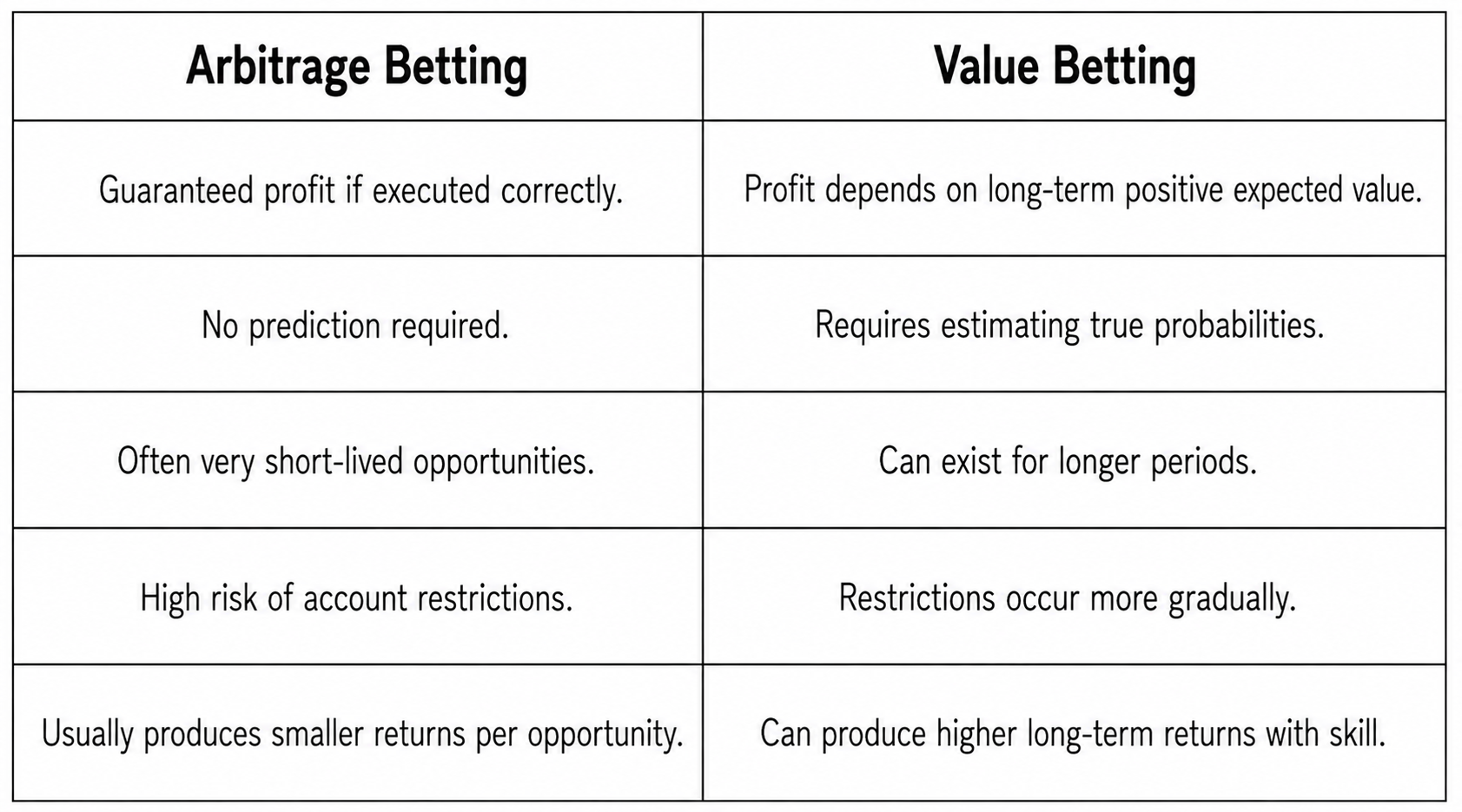
Professional bettors often use specialised software that scans hundreds of bookmakers simultaneously.
These tools automatically identify situations where the combined implied probability falls below 100%.
Some bettors execute the arbitrage directly, while others simply use the information to identify value bets before the market adjusts.
This second approach is generally more sustainable because it attracts less attention from bookmakers.
Sports arbitrage allows bettors to lock in a guaranteed profit by backing every possible outcome at prices where the combined implied probability is below 100%. While the mathematics is straightforward, practical challenges such as rapidly changing odds, stake limits, account restrictions, and voided bets make pure arbitrage difficult to sustain. Many experienced bettors therefore use arbitrage detection primarily as a way to identify value opportunities rather than relying on arbitrage alone.
