Although the principles of live betting are similar across all sports, every sport has its own unique pace, scoring system, and market behaviour.
Understanding these differences is essential because a strategy that works well in one sport may perform poorly in another.
The most successful live bettors specialise rather than trying to master every sport simultaneously. They focus on competitions where they understand the game, recognise market behaviour, and can identify value opportunities consistently.
Before specialising in live betting, consider three important questions:
The better you understand the sport, the easier it becomes to recognise whether the market has reacted appropriately.
Every pricing algorithm has limitations. Some sports present more opportunities for pricing errors than others.
Lower bookmaker margins leave more room for bettors to find value over the long run.
These three factors often matter more than simply choosing the sport you enjoy watching the most.
Football is the world's largest live betting market, attracting enormous betting volume and highly sophisticated pricing models.
Because of its popularity, bookmaker algorithms react very quickly to major events such as goals, red cards, and penalties.
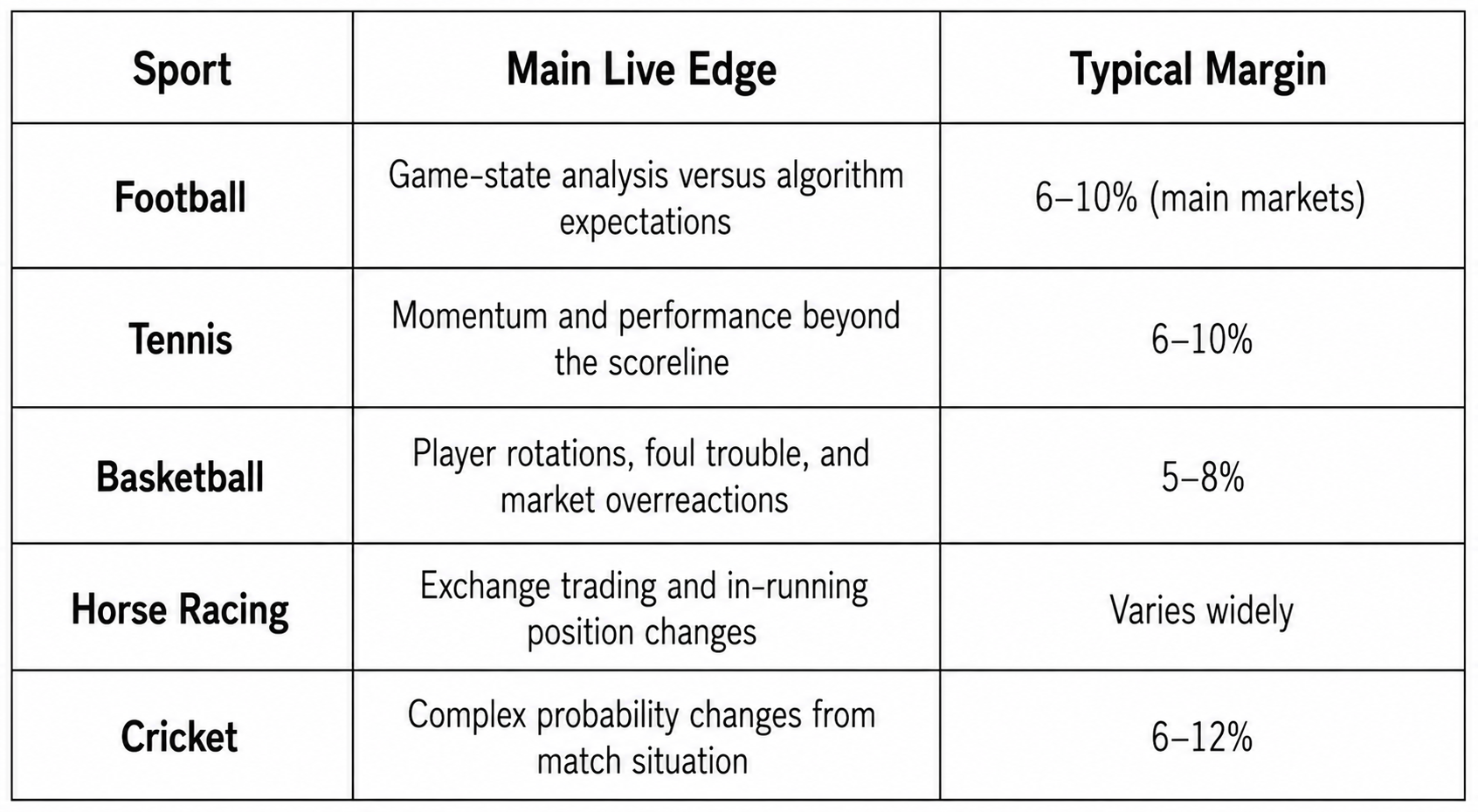
Since reacting faster than the bookmaker is difficult, successful football bettors usually focus on understanding the overall state of the match rather than individual events.
Factors such as expected goals (xG), territorial dominance, sustained attacking pressure, and tactical changes may provide insights that standard models do not fully capture.
For example, a team may trail 1–0 despite dominating the match statistically. If the market focuses too heavily on the scoreline, attractive prices may occasionally appear.
Tennis produces one of the most dynamic live betting environments because every point changes the probability of winning.
Unlike football, there are generally no long market suspensions between points, allowing prices to update almost continuously.
Markets sometimes place too much emphasis on the current score while underestimating the quality of play.
A player may win a set despite being consistently outplayed on serve or relying on unusually efficient break-point conversion.
Experienced bettors often look beyond the scoreboard by considering factors such as first-serve percentage, return performance, and the quality of service games.
Basketball features frequent scoring, causing betting markets to update almost constantly throughout the game.
Because points are scored so regularly, algorithms generally perform well at estimating probabilities.
Short scoring runs sometimes create emotional reactions among recreational bettors.
The market may temporarily overreact when one team scores several baskets in succession, even though basketball games often contain multiple momentum swings.
Player-specific situations can also be important.
For example, early foul trouble for a key player may significantly reduce a team's chances even before the market fully reflects that impact.
Horse racing differs from most team sports because the majority of betting activity occurs before the race begins.
Some bookmakers offer limited live betting, while betting exchanges provide active in-running markets throughout the race.
Exchange markets can move dramatically within seconds as horses gain or lose ground.
However, participants using faster pictures or trackside data often have a significant speed advantage over television viewers.
Understanding this information gap is critical before attempting in-running racing strategies.
Cricket has some of the most complex live betting markets because probabilities change continuously throughout long matches.
The wide variety of match formats—from Twenty20 to Test cricket—creates very different betting environments.
The complexity of cricket creates opportunities for pricing errors, particularly in less popular competitions.
However, it also increases the difficulty of accurate analysis.
Bettors should have a solid understanding of match situations, batting resources, and game formats before attempting advanced live cricket betting.
Most professional bettors focus on one or two sports rather than attempting to master everything.
Specialisation allows you to:
Depth of knowledge generally produces better long-term results than spreading attention across many unrelated markets.
Every sport has its own live betting characteristics, shaped by its scoring system, pace of play, market liquidity, and bookmaker pricing models. Football rewards understanding of overall game state, tennis demands close attention to underlying performance, basketball requires awareness of momentum and player availability, horse racing emphasises information speed, and cricket presents complex probability dynamics. Choosing one or two sports to specialise in allows bettors to understand market behaviour more deeply and identify value opportunities more consistently.
